The short paper
EVERYTHING, ON ONE PAGE
There is no forty-page whitepaper. There is no roadmap. Here is the entire machine, including the parts that are bad for you.
01 THE ONE-SENTENCE VERSION
You hire cats with $CATS. The building pays them wages every day. You own the cats, so you keep the pay — sell it, or hire more.
That is the whole game. Everything below is detail about how fast, how many, and where the money actually comes from.
02 THE POOL
The earning pool holds 8,820,000 $CATS — 98% of total supply, locked in the contract. That number only ever goes down. There is no mint function — not for you, not for us.
Cats do not create $CATS. They take them out of the shared pool. So the more cats there are in the world, the faster it drains, and the smaller every slice gets. This is the opposite of how most of these games pretend to work, and it is the honest bit that makes the rest defensible.
03 WHO PAYS YOU, AND IS THERE ENOUGH
Nobody pays you. There is no treasury sending out rewards and no wallet we top up. On launch day the pool is put into the contract once and the contract hands it out on its own, forever, to whoever presses collect.
Is there enough? Yes, with room:
- The pool will pay out 8,820,000 $CATS — 98% of everything that exists.
- All 11,350 cats added together cost about 700,000 $CATS.
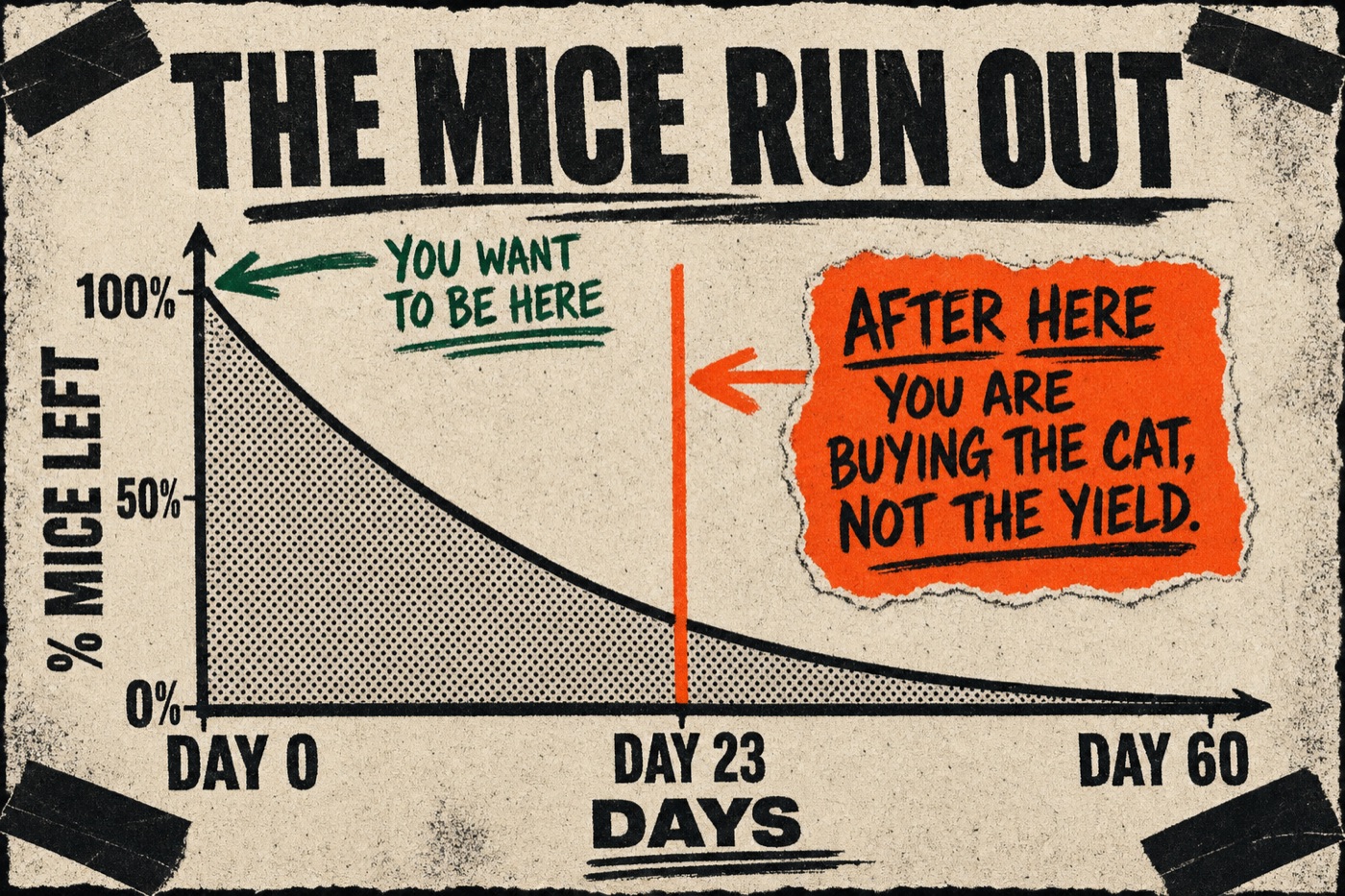
So over ten times more comes out than goes in. But it does not come out evenly, and the gap is brutal. Emission is a fixed number of $CATS a day split by share of cat power, and it halves every 30 days. Hire ONE SCREEN on day one and it pays for itself the same day. Hire the same cat on day forty-five and it never does.
Put plainly: in $CATS, everyone can win. In dollars, they cannot. Those 55 million $CATS have to be sold to somebody, and the only structural buyer is a person buying cats — who put in 17.5 million. The gap is where an early player's profit comes from, and it comes out of a late player's pocket. That is true of every game shaped like this. We would rather write it down than let you find out on day forty.
04 THE CATS
Seven kinds of worker. Supply of each is fixed forever, and there is no order to follow — hire any of them first. Price follows a bonding curve: every cat hired makes the next one dearer, ending 2.5× above where it opened.
A cat does not make $CATS. It takes a share of the fixed 147,000 $CATS a day the whole building earns, in proportion to its power. Every cat anybody hires makes everyone's share smaller, and the 147,000 halves every 30 days.
The first buyer in a tier pays the least and earns for the longest at high density. That is the whole reward for being early — not a bonus, just arithmetic.
05 WHAT IS NOT IN HERE
We designed a second row of cats — legends, tiny supply, a bigger referral cut. They are not in the contract. It knows seven kinds of worker and one referral rate, and that is all it will ever know.
They cannot be added later either. There are no admin functions, which is the whole trust story and also means nothing can be bolted on afterwards. Legends would need a second contract, and we are not promising one.
This section stays instead of quietly disappearing, because a paper that only lists what works is a brochure. Everything else in this document is in the code and you can check it.
06 WHERE CATS GO TO DIE
Two sinks run constantly, and both burn:
- Buying a cat. 75% of the price is burned, 25% goes to the treasury. Every purchase is buy pressure, because the only way to get $CATS is to buy it.
- Feeding. Every claim gives up 20% to feed the cat. Burned.
The shape matters more than the total: heavily deflationary in the first fortnight while everybody is buying cats, inflationary after that as emission keeps landing. Plan accordingly.
07 REFERRALS
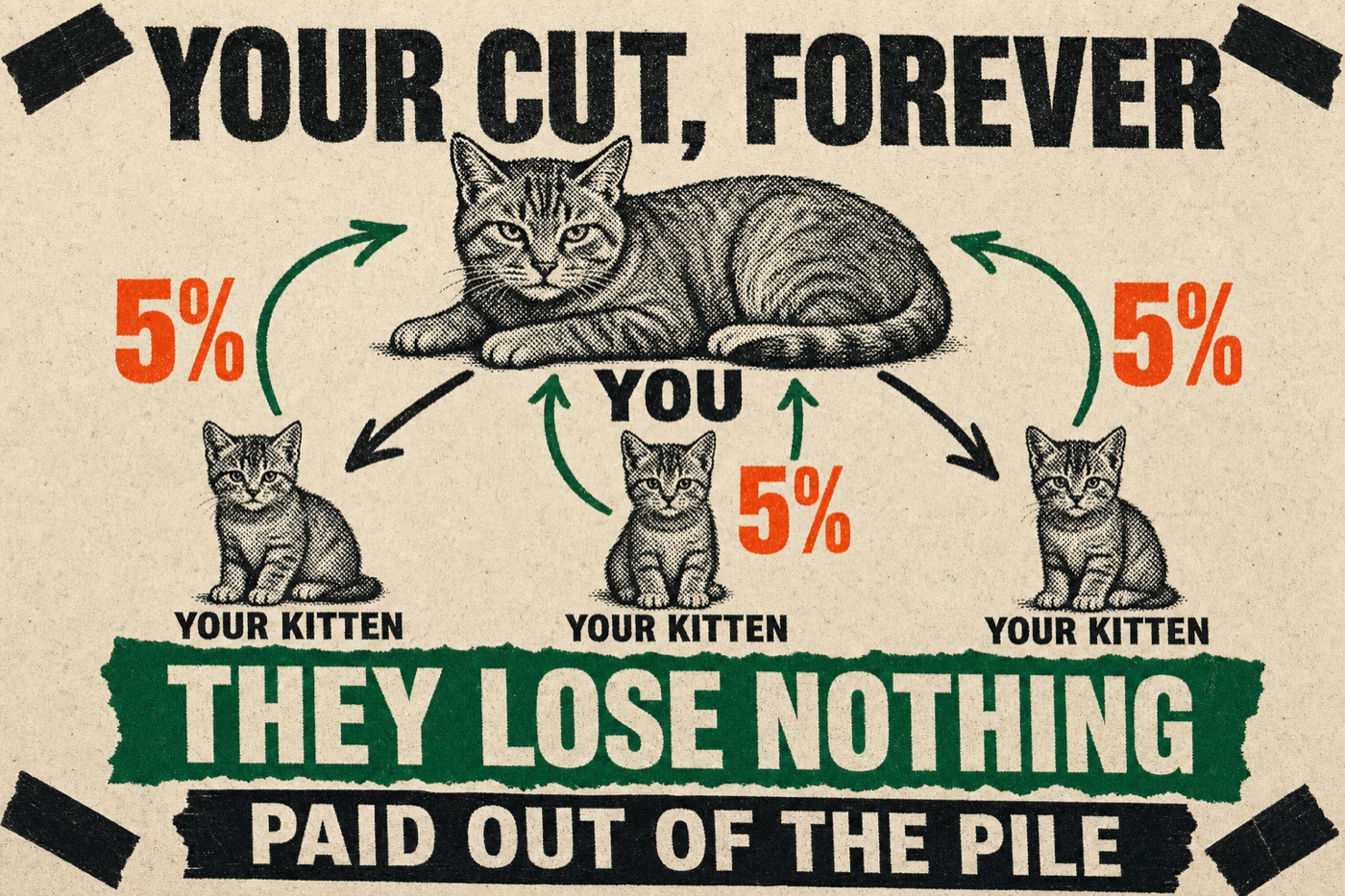
5% of everything your referral ever earns, for as long as they play, paid out of the pool rather than out of their earnings. Bring someone in and they lose nothing. The rate is a constant in the contract: 5%, for everyone, forever.
08 HOW WE GET PAID
There is no team allocation. The launchpad does not have a mechanism for one, so this is not a promise, it is a fact about the platform.
Money reaches us two ways: 25% of every cat sale, and 70% of the 1% swap fee on the liquidity pool, which is the launchpad's standard creator share. Both mean we earn when the game is used and traded, not when we sell a bag. There is no bag to sell.
09 SEASONS
Season one is finite by construction. When the pool runs low, season two is funded by buying $CATS back off the open market with accumulated fee revenue.
Which is worth stating plainly: season two's $CATS are bought, not printed. Nothing about season one's supply changes to make it happen.
10 WHY YOU MIGHT LOSE MONEY
- Buy in late and your cat never pays for itself on earnings alone. The calculator on the front page will tell you exactly when that starts.
- The token price can fall further and faster than your cat earns.
- Once the pool is spent, a cat's floor tends toward whatever the next buyer will pay, which may be nothing.
- It is a game about greed on a chain that is weeks old. Treat the money as spent the moment you send it.
Every project of this shape has these properties. Most just decline to write them down.